More irresistible stuff

Showing posts with label Engineering for Writers. Show all posts

Tuesday, 8 March 2011

Engineering for Writers #3

Today we are going to be thinking about force and pressure.

Every so often I come across a writer who uses one when they mean the other, so I thought I would do the writing world a favour and explain the difference.

Force is a measure of how much you push something, or how much you bear down on the ground, or the turning effect of a car engine on the wheels. We feel the force of the wind as it's gusts make us stagger, or as it sends a boat creaming through the water. We talk about being forced to do something if we are compelled to do it when we would not otherwise have done so.


Pressure is a measure of how much that force is spread out. The smaller the area over which the force acts, the greater the pressure. The force of the wind spread out over the area of a sail creates a pressure that can be seen in the way that the sail billows, but it is the force that drives the boat along.


Here's an interesting fact. When your kick-ass heroine stomps on the foot of the goon holding her with her size 5 stilettos, she is exerting more pressure than the articulated lorry that is concurrently running over the foot of the goon's side-kick. For proof the lorry weighs 1200 times as much as your delectable MC, but the lorry's weight is spread over 12 tyres, each tyre making contact with the ground over an area 800 times the size of a stiletto. So in total 1200 times the weight spread over 9600 times the area, meaning the stiletto exerts 8 times the pressure. If you didn't follow that, don't worry. Just remember to make your goon's eyes water.

A politician is forced to resign due to intense media pressure. There is a force applied by the media spread over a period of time (rather than area, as we talked about before)

So a force is an active, doing word that has results (which might be action or it might be a bruised toe). Pressure is a more passive word which describes how the force acts. You are knocked over by the force of a wave, not by it's pressure.

So on to today's MYTHBUSTER



Weight is also a force. It is a measure of how much we press down upon the earth. When we stand on our bathroom scales they measure our weight, yes, but the reading it gives us is NOT our weight. Bathroom scales read in lbs or kg which are units of MASS not WEIGHT. All the while we are running around on the face of the earth, this little deception doesn't really matter. However if you took your bathroom scales to the moon, instead of your usual 120lbs (55kg) of mass, it would tell you that your mass had reduced to 20lbs (8.5kg). As the only way of losing mass is a diet or having bits chopped off, such a loss of mass would be catastrophic. Correctly your scales, back in your bathroom, should tell you that you weigh 120lbf (pounds force being a measure of, you guessed it, force) or 550N (Newtons - 10 newtons is the force exerted by 1kg of mass in standard earth gravity). Technically, when you overindulge at Christmas you put on mass, but if you tell your work colleagues that you put on a little mass at Christmas, they'll think you've gone all religious!

Tuesday, 1 March 2011

Engineering for Writers #2

Today we will be looking at ... Spans

Let's get some building terms straight.

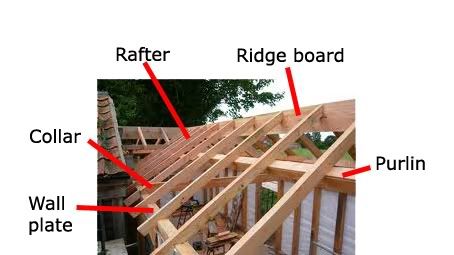
Here is a typical roof (terms are UK of course)


The slates or tiles are nailed to battens which run from side to side and are nailed to the rafters. The rafters run from the wall plate at the bottom, to the ridge board at the top. The ridge board does not carry any weight. The rafters are supported by the purlin which spans between trusses or between gable ends.


Here is a nice example of a king post truss supporting two rows of purlins

I tell you all this in case you ever want to avoid using the generic fudge of "roof beams" to mean any bit of timber up in the roof!

Joists are "beams" which are laid horizontally to support the floor (floor joists) or ceilings (ceiling joists). I know, complicated names huh?!

The beam which supports the wall above windows or doors is called a lintel.

Here is something interesting. If you halve the width of a beam, it is half as strong and twice as bouncy. (technical term of course!). If you halve the depth of the beam it is only one quarter as strong and eight times as bouncy!

So - on to arches


The picture above shows us two things. First it helps us imagine what would happen if the keystone - the critical locking piece - is missing. You can just imagine the stones to either side simply sliding off into the river below. BUT with the keystone in place you can see how all the stones would be wedged together. What happens here is that all the vertical load you are putting onto the bridge (sorry, not making suggestions about your weight) is being translated into horizontal force at the ends of the arch. This is why you need something strong at either end to stop the arch from spreading.

We at arrive at last at this week's MYTH-BUSTER.

You remember this scene from The Fellowship of the Ring?


Gandalf is standing on the centre of the span, right on the keystone, facing down the Balrog. "You" he says. "Shall," he continues. "Not," he adds. "Pass!" With that he strikes the bridge and half of it collapses under the feet of the Balrog. Impossible! Either the whole bridge collapses or none at all. A more realistic version would be for the whole bridge to have collapsed taking both Gandalf and the Balrog into the abyss. Gandalf's final shout of "Fly you fools!" as he plummeted would have been even more poignant. It might not have made as good cinematics, but it wouldn't have made the engineer in me shake my head in despair!

Tuesday, 22 February 2011

Engineering for Writers

As I am a professional engineer, I thought I would share some knowledge with you in a series of engineering related articles. If I can help to add some authenticity, or at least help you to avoid some of the engineering fallacies that I hear in popular culture, then I will have achieved my aim. How's that for a bit of bloviating?!

The first topic on the agenda is SEWERAGE.

Don't you love it when I talk dirty?

First let's get some terms sorted.

A drain serves a single source, such as a house, or a factory or a highway. A sewer serves more than one property, or source. The network of sewers is called sewerage - not to be confused with sewage which is the smelly stuff that flows in a sewer.

A sewer can either carry just rainwater, in which case it is called a surface water or stormwater sewer or it can carry dirty water in which case it is called a foul or sanitary sewer. Older sewers, particularly those in cities, carry both rainwater and dirty water and are called combined sewers. It is these combined sewers which can be very large - sufficiently large for a person to walk in.


On the subject of size. 1000 houses would produce, on average, a FOUL WATER design flow of 45 litres per sec, and would need a pipe 225mm or 9 inches in diameter. Not something your hero would fit into. On the other hand 1000 houses would produce 1400 l/s in STORMWATER runoff in the sort of storm that you might see once a year. (This depends on where in the world you are - the figure quoted is relevant to the UK). This would need a pipe 900mm or 3 feet in diameter. Large enough to crawl in. However, your hero should beware - it takes 4 minutes for rainwater to work it's way into the sewer, with the flows building to a peak in 10 to 30 minutes depending on the network. I mention all of this just in case your hero should ever get trapped in a sewer during a rainstorm! Sadly the truth is that every year people are drowned in sewers, all too often children who think it is cool to hang out in their "den" which might have been cosy and dry for weeks.


Assuming you haven't zoned out by now here is a MYTH-BUSTER. The idea of a fish being flushed down a toilet finding its way to the sea is, alas, nonsense. (Even for Nemo!). Even if you live in a seaside town where flows can sometimes discharge to the sea, sewage has to pass through a screen with only 6mm gaps (1/4"). That is enough to stop the solids, sanitary towels and piscine escape artists. Inland, the sewers run to Treatment Works, where the sewage is screened, solids are removed in flocculation tanks, sedimentation tanks, and the resulting liquid is sprayed onto gravel filtration beds. Not a good place for a fish.


One last note. The large sewers have only been around since the 19th century. Not strictly accurate to have your medieval protagonist escaping through the sewers. In medieval times, householders disposed of their waste into a cesspool which was emptied daily by the night soil men. (A real lowest of the low job). Other waste ran in open channels in the road.


I hope this article has given you something to think on, and you never know, perhaps one day it might come in handy!